
Have you recently started moving your phone farther away to read a message?
Maybe restaurant menus look fine in bright light but become frustrating in a dimly lit room.
Or perhaps you can still see perfectly well across the room, but reading the small print on a medicine label suddenly takes more effort.
If you have found yourself asking:
“Why can’t I read up close anymore?”
Presbyopia may be the reason.
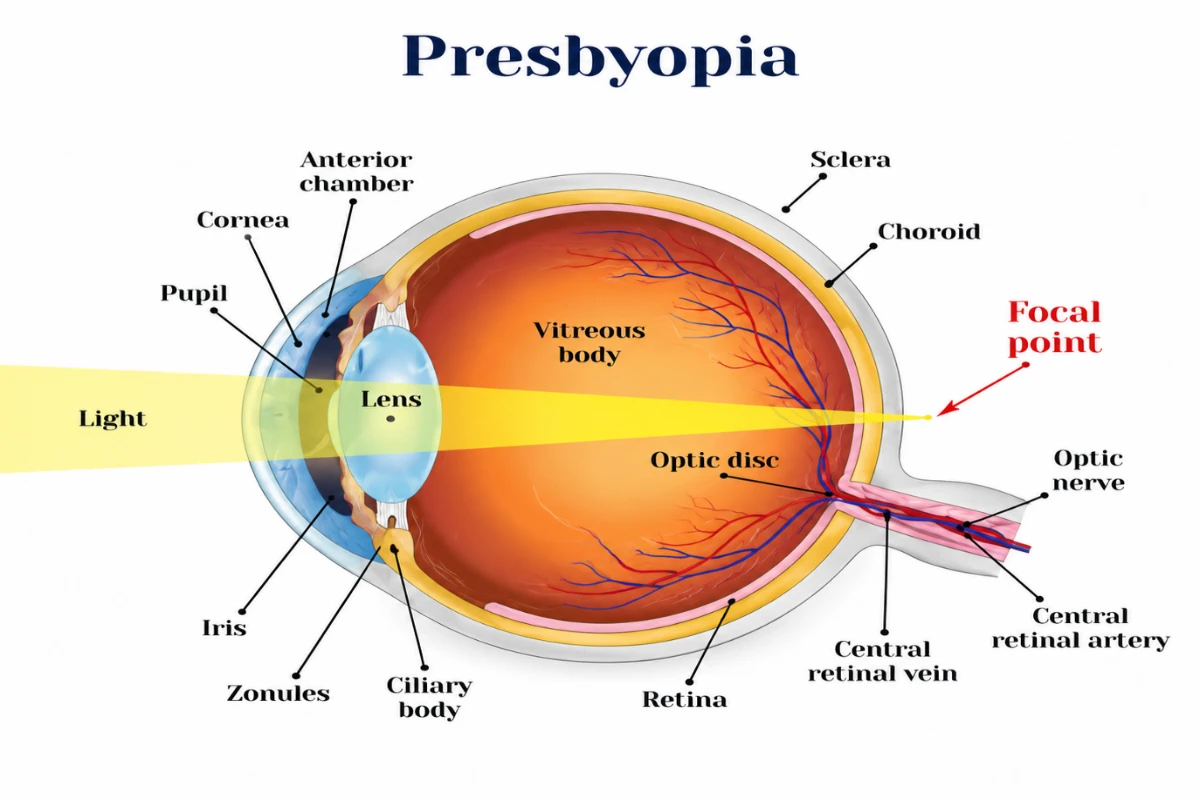
Presbyopia is a normal age-related change in the eye’s ability to focus on nearby objects. It commonly becomes noticeable during middle age as the natural lens inside the eye becomes less flexible.
It is not an eye disease.
But because vision changes should not automatically be assumed to be “just ageing,” an eye examination can help determine whether presbyopia is the explanation or whether another eye condition also needs attention.
For Dr Mandeep Lamba, whose clinical work includes retinal and vitreous conditions, vision changes are best understood by looking beyond the symptom alone and assessing the overall health of the eye.
What Is Presbyopia?
Presbyopia is an age-related refractive change that makes it increasingly difficult to focus clearly on objects at close distances.
When you are younger, the natural lens inside your eye is flexible.
When you look at something nearby, the lens changes shape to help focus light correctly onto the retina. This focusing process is known as accommodation.
As we age, the lens gradually becomes harder and less flexible.
Eventually, it cannot change shape as effectively as it once did.
The result?
Your distance vision may remain relatively clear, while reading, texting or looking at something close becomes more difficult.
Presbyopia usually starts becoming noticeable after around age 45, although the exact timing and symptoms vary from person to person.
Why Does Reading Up Close Suddenly Become Difficult?
Presbyopia often feels as though it appeared suddenly.
In reality, the change usually happens gradually.
For a while, your eyes compensate.
You may instinctively:
- move your phone slightly farther away
- increase screen brightness
- make text larger
- hold menus at arm’s length
- choose brighter areas for reading
Eventually, however, your usual reading distance may no longer feel comfortable.
That is often when people first notice that something has changed.
The issue is not that your eyes have suddenly become “weak.”
The natural focusing mechanism of the eye has gradually changed with age.
Common Presbyopia Symptoms
The most recognisable presbyopia symptoms involve difficulty with near vision.
You may notice:
1. Small Print Looks Blurry Up Close
Text on your phone, books, food labels or menus may no longer appear as sharp at your usual reading distance.
2. You Keep Holding Things Farther Away
The classic sign is moving reading material farther from your face until it becomes clearer.
At some point, you may feel that your arms are “not long enough.”
3. You Need More Light to Read
Reading may feel comfortable in bright daylight but more difficult in a dim restaurant or bedroom.
4. Your Eyes Feel Tired After Close Work
Long periods of reading, scrolling or computer work may leave your eyes feeling strained or uncomfortable.
5. Headaches After Reading
Some people develop headaches after prolonged close-up tasks because they are working harder to maintain focus.
6. Switching Between Near and Far Takes More Effort
You may notice a short delay when moving your focus from your phone to something across the room.
The National Eye Institute lists difficulty seeing things up close, holding reading material farther away, eye strain and headaches among common symptoms of presbyopia.
“Why Can’t I Read Up Close Anymore If My Distance Vision Is Fine?”
This is one of the most common questions people have when presbyopia begins.
The reason is that distance vision and near focusing are not the same process.
You may have excellent distance vision and never have needed glasses earlier in life.
But reading something close requires your natural lens to adjust its focusing power.
With presbyopia, this near-focusing ability gradually reduces.
So it is entirely possible to:
see road signs clearly
but
struggle to read a WhatsApp message at your normal reading distance.
That combination is common in presbyopia.
Is Presbyopia the Same as Farsightedness?
No.
They can both cause difficulty seeing up close, but they develop for different reasons.
Farsightedness or Hyperopia
Hyperopia is a refractive error related to the optical shape and focusing characteristics of the eye.
It can occur at different ages.
Presbyopia
Presbyopia develops because the natural lens becomes less flexible with age.
It is an age-related focusing change.
A person can also have presbyopia together with myopia, hyperopia or astigmatism.
That is another reason why simply buying a pair of reading glasses without understanding your prescription may not be the ideal approach for everyone.
Does Everyone Develop Presbyopia?
Presbyopia is considered a normal part of ageing.
However, people experience it differently.
One person may notice reading difficulty relatively early, while another may manage comfortably for longer.
How noticeable your symptoms are can also depend on:
- your existing glasses prescription
- your usual reading distance
- the type of work you do
- lighting
- your visual demands
- whether you use contact lenses
- other eye conditions
For example, someone who spends many hours doing detailed near work may notice the change sooner simply because near vision plays a larger role in their daily activities.
Is Presbyopia Caused by Too Much Screen Time?
No.
Using your phone or computer does not cause the age-related lens changes responsible for presbyopia.
However, prolonged screen use can make the symptoms more noticeable.
If your near focusing is already becoming less efficient, hours of:
- reading emails
- reviewing documents
- texting
- scrolling
- working on spreadsheets
- looking at small digital text
may make your eyes feel more tired.
Digital eye strain and presbyopia can therefore occur at the same time, but they are not the same condition.
Persistent near-vision difficulty should not automatically be blamed on screens.
Why an Eye Examination Matters When Near Vision Starts Changing
It can be tempting to assume:
“I am over 40, so this must just be presbyopia.”
Often, presbyopia is indeed the explanation.
But a vision change still deserves appropriate assessment, particularly if it is new, asymmetric, persistent or accompanied by other symptoms.
A comprehensive eye examination can assess not only your reading prescription but also other aspects of eye health.
Depending on your clinical needs, the examination may include:
- distance and near vision
- refraction
- eye alignment and movements
- pupil responses
- eye pressure
- corneal examination
- natural lens assessment
- optic nerve assessment
- retinal examination
Additional investigations may be considered if something in your symptoms, medical history or examination requires further evaluation.
Dr Mandeep Lamba’s Approach: Looking Beyond the Reading Glasses
When someone presents with changing vision, the useful question is not simply:
“What strength reading glasses do you need?”
It is also:
“Is presbyopia the complete explanation for this change?”
For Dr Mandeep Lamba, whose clinical work includes retinal and vitreous conditions, understanding a vision change involves considering the eye as a whole.
That may include assessing whether symptoms are consistent with normal age-related focusing changes while also considering:
- the retina
- vitreous
- natural lens
- optic nerve
- refractive status
- existing medical conditions
- previous eye problems
- the pattern of the visual symptoms
For many patients, the findings may be consistent with presbyopia.
For others, an examination may identify an additional reason why vision has changed.
The appropriate recommendation therefore depends on the individual examination rather than age alone.
Presbyopia Treatment: What Are the Options?
If you are searching for presbyopia treatment in Dubai, it is important to understand that treatment is not necessarily about reversing the ageing process of the natural lens.
Most options are designed to help compensate for the loss of near focusing.
The most appropriate option depends on your existing prescription, lifestyle, work, eye health and visual expectations.
1. Reading Glasses
For some people, simple reading glasses are enough.
They are worn mainly for close-up activities such as:
- reading
- phone use
- sewing
- paperwork
- other detailed near tasks
People who do not otherwise require distance glasses may find this option straightforward.
However, the correct strength can change over time.
2. Prescription Reading Glasses
If you have astigmatism or another refractive error, prescription reading glasses may provide more personalised correction than standard over-the-counter readers.
An eye examination determines the prescription required for each eye.
3. Bifocal or Progressive Glasses
If you need correction for both distance and near vision, your ophthalmologist or optometrist may discuss multifocal spectacle options.
Bifocals
These contain separate zones for distance and near vision.
Progressive Lenses
These provide a gradual transition between distance, intermediate and near vision.
They can be particularly useful for people who frequently switch between:
driving → computer → phone
during the day.
4. Contact Lens Options
Some people may be suitable for contact lenses designed to help with different viewing distances.
Options can include multifocal contact lenses or a strategy known as monovision, where the eyes are corrected differently for distance and near tasks.
These approaches are not suitable or comfortable for everyone.
A contact lens assessment and discussion of visual requirements are important before deciding whether they are appropriate.
5. Procedural or Lens-Based Options
Some patients ask whether presbyopia can be managed without relying entirely on reading glasses.
There are procedural and lens-based approaches that may be considered in selected patients.
However, suitability depends on several factors, including:
- age
- prescription
- corneal health
- natural lens changes
- retinal health
- other eye conditions
- lifestyle
- visual expectations
No procedure should be presented as the universally preferable option for presbyopia.
Potential benefits, limitations and risks need to be discussed based on the individual patient’s examination and the specific procedure being considered.
Which Presbyopia Treatment Is Right for You?
There is no single answer.
Two people of the same age may need completely different solutions.
For example:
Patient A:
Has good distance vision and mainly struggles with occasional reading.
Simple reading glasses may be sufficient.
Patient B:
Needs correction for distance, computer work and reading throughout the day.
A multifocal spectacle solution may be considered.
Patient C:
Prefers contact lenses and has appropriate eye health.
Different contact lens strategies may be discussed.
Patient D:
Is interested in reducing dependence on glasses.
A more detailed assessment would be required before discussing whether a procedural option is appropriate.
This is why presbyopia treatment in Dubai should begin with understanding your eyes and your visual requirements rather than choosing a treatment based only on age.
Can Presbyopia Get Worse?
Presbyopia typically progresses gradually as the natural lens continues to lose flexibility.
This means the reading correction you need in your mid-40s may not be the same correction you need several years later.
According to the National Eye Institute, presbyopia generally progresses over time and commonly stabilises later in life.
Periodic eye examinations allow your prescription and overall eye health to be reassessed as your vision changes.
When Near-Vision Changes May Not Be Just Presbyopia

Not every change in vision after 40 should automatically be labelled presbyopia.
Arrange an ophthalmic assessment if you experience:
- sudden rather than gradual vision change
- marked difference between the two eyes
- distorted vision
- double vision
- new flashes of light
- sudden onset or increase in floaters
- a curtain or shadow in your vision
- unexplained loss of vision
- eye pain or significant redness
Presbyopia typically causes gradual difficulty with near focusing.
Sudden visual symptoms need to be evaluated according to their cause rather than attributed to normal ageing.
This distinction is particularly important from Dr Mandeep Lamba’s retinal perspective, as new flashes, a sudden increase in floaters or a curtain-like area in the vision can be associated with vitreous or retinal changes that require prompt ophthalmic assessment.
Conclusion: When Your Reading Distance Changes, Understand Why
Finding yourself holding your phone farther away can feel like a surprisingly sudden change.
But presbyopia is a normal part of how the eye ages.
The important point is not simply to accept every vision change after 40 as inevitable.
It is to understand what has changed and why.
A comprehensive eye assessment can determine whether your difficulty reading up close is consistent with presbyopia, identify your current prescription and assess other areas of eye health where clinically appropriate.
For Dr Mandeep Lamba, whose clinical work includes retinal and vitreous conditions, changes in vision are considered in the context of the whole eye rather than the reading prescription alone.
If presbyopia is the cause, the next question is not:
“What is the best treatment?”
It is:
“Which option is appropriate for my eyes, my work and the way I use my vision every day?”
That may mean reading glasses for one person, progressive lenses or contact lenses for another, or a discussion about additional options in selected patients.
The recommendation should always follow the examination.
Frequently Asked Questions About Presbyopia
1. What are the first symptoms of presbyopia?
Early presbyopia symptoms commonly include difficulty reading small text at your usual distance, holding your phone farther away, needing brighter light and experiencing eye strain during close work.
2. At what age does presbyopia usually start?
Presbyopia commonly becomes noticeable during the 40s, often after approximately age 45. The timing and severity vary between individuals.
3. Why can’t I read up close anymore?
If the change has developed gradually during middle age, presbyopia may be responsible.
As the natural lens becomes less flexible, the eye has more difficulty adjusting its focus for nearby objects.
An eye examination can confirm whether presbyopia is the explanation.
4. Can I have presbyopia even if my distance vision is perfect?
Yes.
Presbyopia specifically affects the ability to focus on nearby objects. You may continue to have clear distance vision while finding your phone, books or other close-up tasks increasingly difficult.
5. Does using a phone make presbyopia worse?
Phone use does not cause the age-related lens changes responsible for presbyopia.
However, prolonged close-up screen use can make symptoms such as eye strain or focusing difficulty more noticeable.
6. Can presbyopia be corrected with glasses?
Yes. Reading glasses, prescription reading glasses, bifocals and progressive lenses are among the commonly used ways of correcting near vision in presbyopia.
7. Are reading glasses the only treatment for presbyopia?
No.
Depending on your prescription, eye health and lifestyle, options may include different spectacle designs, contact lens strategies and, in selected patients, procedural or lens-based approaches.
An assessment is needed to determine which options are relevant to you.
8. Do I need an eye exam before buying reading glasses?
Some people use over-the-counter reading glasses successfully, but an eye examination provides more information than reading strength alone.
It can assess whether both eyes need the same correction and whether another refractive or eye-health issue is contributing to the symptoms.
9. Is presbyopia permanent?
Presbyopia results from age-related changes in the natural lens and focusing system of the eye.
Current correction strategies help compensate for the loss of near focusing rather than stopping the underlying ageing process.
10. When should I consider presbyopia treatment in Dubai?
If near-vision difficulty is beginning to interfere with reading, computer work, phone use or other everyday activities, an eye assessment can determine whether presbyopia is responsible and discuss the correction options appropriate for your eyes and lifestyle.


