
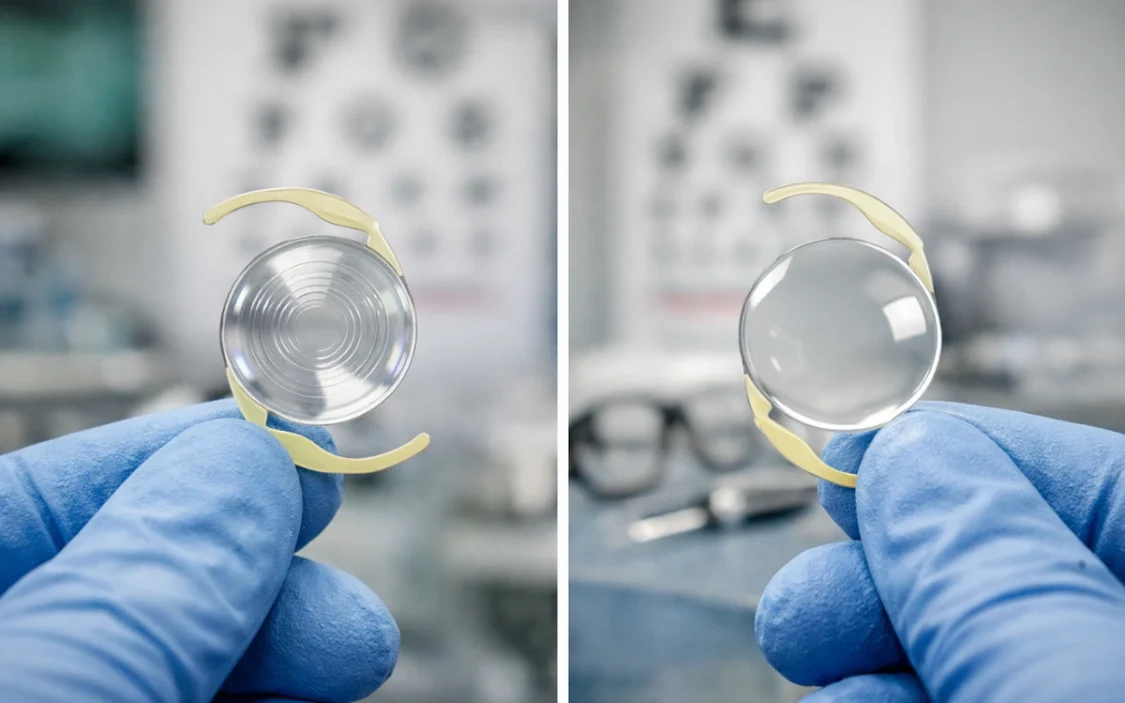
Choosing between multifocal IOLs and monofocal IOLs is one of the most important decisions you’ll make before cataract surgery. The lens you select will shape how you see the world for the rest of your life, whether you’re reading a book, driving at night, working on a laptop, or simply enjoying daily activities without constantly reaching for glasses.
The truth is: there is no single “best” lens for everyone. The right choice depends on your eyes, your lifestyle, and what you value most in your vision. Some patients want maximum sharpness and don’t mind wearing reading glasses. Others want maximum freedom from glasses and are comfortable with minor trade-offs.
This guide breaks everything down clearly so you can make a confident, informed decision.
Why Lens Choice Matters More Than You Think
Cataract surgery replaces your cloudy natural lens with a clear artificial intraocular lens (IOL). This is your one opportunity to improve not just clarity, but how your vision works at different distances. A rushed decision can lead to disappointment later, while the right lens often results in higher satisfaction and fewer surprises.
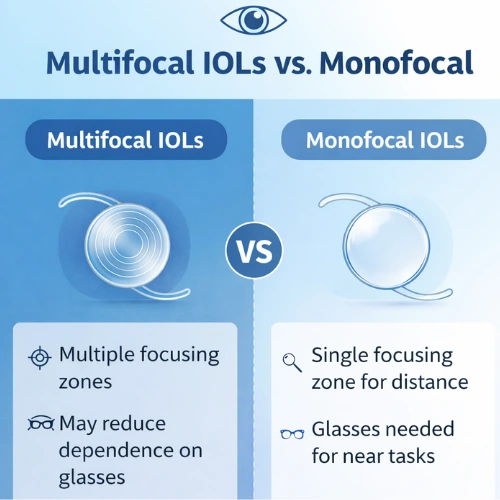
- Monofocal IOLs focus light at one distance (usually set for clear distance vision).
- Multifocal IOLs have multiple focusing zones built into the lens, allowing clear vision at near, intermediate, and distance ranges.
In simple terms:
Monofocal lenses give excellent quality at one distance.
Multifocal lenses aim to reduce your dependence on glasses across multiple distances.
| Feature | Monofocal IOLs | Multifocal IOLs |
| Vision at Distance | Excellent sharpness | Very good |
| Intermediate (Computer) | Usually needs glasses | Good to excellent |
| Near (Reading/Phone) | Needs reading glasses | Good to excellent |
| Spectacle Independence | Lower | Significantly higher |
| Night Driving & Glare | Fewer halos and glare | Possible halos/glare (especially first few months) |
| Contrast Sensitivity | Excellent | Slightly reduced in low light |
| Best For | Patients who prioritise sharpness and simplicity | Active patients who want freedom from glasses |
| Suitable Eyes | Works well even with mild retinal or corneal issues | Best when eyes are otherwise healthy |
Who May Be Happier with a Monofocal Lens?
You may prefer monofocal IOLs if:
- You want the sharpest possible vision at one distance
- You don’t mind using reading glasses for close work
- You drive a lot at night or in low light
- You are sensitive to halos or glare
- You have other eye conditions (e.g., mild macular degeneration or irregular cornea)
Many patients choose monofocal lenses and are extremely happy, especially when they know exactly what to expect.
Who May Be Happier with a Multifocal Lens?
Multifocal IOLs often suit patients who:
- Want to reduce or eliminate their dependence on glasses
- Have an active lifestyle with frequent reading, phone use, and screen work
- Are willing to accept a short adaptation period
- Have healthy eyes with no significant retinal or corneal issues
Modern multifocal and trifocal designs have improved significantly, offering better contrast and fewer side effects than older generations.
Spectacle Independence After Surgery
This is what most patients care about most.
Multifocal IOLs generally provide much higher spectacle independence; many patients report needing glasses only for very fine print or in extreme lighting.
Monofocal IOLs usually leave a need for reading glasses (and sometimes computer glasses).
However, no lens guarantees 100% freedom from glasses. Realistic expectations are the key to long-term satisfaction.
Common Misunderstandings
- “Premium lenses are always better” → Not true. The best lens is the one that matches your eyes and lifestyle.
- “Monofocal means I’m settling” → False. Many patients love the crisp, reliable vision monofocal lenses provide.
- “Multifocal means I’ll never need glasses again” → Not always. Most patients use them far less, but some still need glasses for specific tasks.
- “The lens decides everything” → The lens is important, but surgical precision, accurate measurements, and overall eye health play equally big roles.
Questions Worth Asking Your Surgeon
- What distance will I see best with this lens?
- How likely am I to still need glasses?
- Will night driving be affected?
- Is my eye health suitable for a multifocal lens?
- What side effects should I realistically expect?
- How does my lifestyle match each option?
Frequently Asked Questions
Will I feel the lens inside my eye?
No. Once implanted and healed, the lens is completely unnoticeable.
Can both eyes receive the same lens type?
Yes, most patients do. In some cases, a “blended” approach (one monofocal + one multifocal) may be discussed.
Are multifocal lenses safe?
Yes — they are FDA-approved and widely used. Success depends on careful patient selection and counselling.
Can retinal problems affect my lens choice?
Yes. Certain retinal conditions may make multifocal lenses less suitable, which is why a detailed pre-surgery examination is essential.
How long does adaptation take?
Most patients adapt within a few weeks. Some notice improvement for up to 3 months with multifocal lenses.
Conclusion
There is no universal “winner” in the multifocal IOLs vs. monofocal debate. The best lens is the one that perfectly aligns with your vision goals, lifestyle, and eye health.
Whether you prioritise crisp distance vision with reading glasses or want maximum freedom from spectacles, modern cataract surgery offers excellent options for both. The key is honest discussion with your eye surgeon in Dubai and realistic expectations.
Ready to find the right lens for your eyes?
For a personalised cataract consultation in Dubai, contact Dr Mandeep Lamba at +971 52 422 7000 at Prime Hospital, Al Garhoud, Dubai. Discuss your lifestyle and get clear guidance on the lens that will serve you best for years to come.


