

Choosing a surgeon for cataract treatment is an important decision. Cataract surgery may be a commonly performed eye procedure, but it still involves removing the natural lens of your eye and replacing it with an artificial intraocular lens.
The surgeon you choose will influence more than the operation itself. They will assess the health of your eyes, calculate the power of the artificial lens, help you decide which visual outcome to target, explain possible risks and manage your recovery after surgery.
When patients search for the best cataract surgeon in Dubai, they often focus on online reviews, clinic interiors, technology or the number of years a doctor has been practising. These factors may provide some useful information, but they do not tell the complete story.
The right surgeon should combine appropriate qualifications, relevant cataract experience, careful preoperative planning, clear communication and dependable follow-up care. They should also be willing to explain what surgery can realistically achieve for your particular eyes.
Before deciding where to have your procedure, ask these eight essential questions.
Why Does Choosing the Right Cataract Surgeon Matter?
A cataract develops when the natural lens inside the eye becomes cloudy. This can cause blurred vision, faded colours, glare, halos around lights, difficulty reading and reduced confidence while driving at night.
During cataract surgery, the cloudy lens is removed and replaced with a clear artificial lens called an intraocular lens, or IOL. Cataract surgery is generally considered safe and effective, but like every operation, it carries possible risks such as infection, inflammation, swelling, changes in eye pressure, retinal detachment and reduced vision.
A successful result does not depend only on removing the cataract. It also depends on:
- Identifying other eye conditions before surgery
- Taking accurate eye measurements
- Selecting the correct lens power
- Choosing an appropriate type of intraocular lens
- Managing astigmatism where necessary
- Performing the operation carefully
- Preventing and managing complications
- Monitoring the eye during recovery
- Setting realistic expectations before the procedure
This is why choosing a cataract surgeon in Dubai should not be based only on advertising claims or the availability of the newest machine.
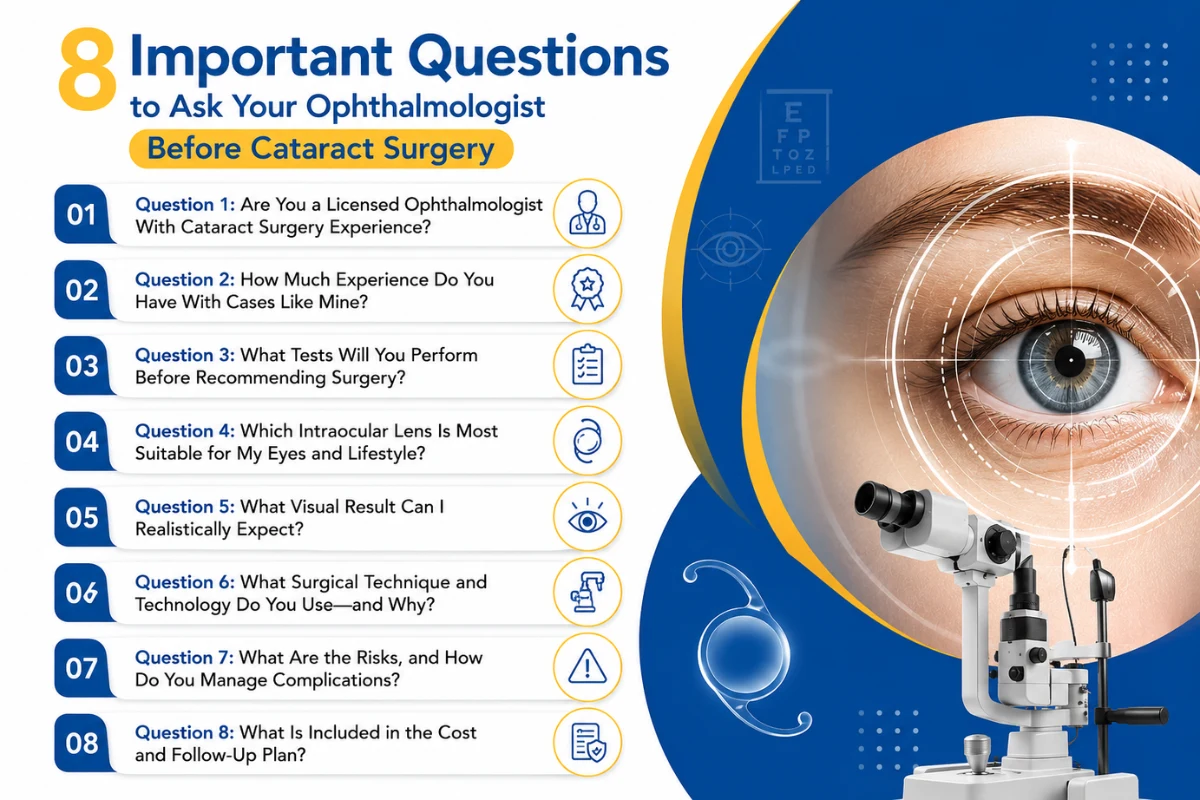
Question 1: Are You a Licensed Ophthalmologist With Cataract Surgery Experience?
The first question should be about the surgeon’s qualifications and licensing.
Cataract surgery should be performed by an ophthalmologist, a medical doctor who is trained to diagnose and treat eye diseases and perform eye surgery.
In Dubai, patients can use the Dubai Health Authority’s Medical Registry and professional licence verification services to check the licensing status of healthcare professionals. The registry may provide details about a professional’s speciality, registration and current licensing status.
You may ask the surgeon:
- What are your ophthalmology qualifications?
- Are you currently licensed to practise ophthalmology in Dubai?
- Did you complete additional training in cataract or anterior-segment surgery?
- How long have you been performing cataract procedures?
- Do you regularly manage straightforward and complex cataract cases?
- Which professional ophthalmology organisations are you associated with?
A licence confirms that the doctor has met the relevant regulatory requirements, but experience in the specific procedure is also important.
A surgeon may have extensive experience in another area of ophthalmology without performing cataract surgery regularly. It is therefore reasonable to ask directly about their cataract practice.
Does the number of years alone identify the best surgeon?
Not necessarily.
Experience matters, but the number of years in practice should not be considered in isolation. A suitable surgeon should also stay updated with changes in diagnostic testing, intraocular lens calculations, surgical techniques and postoperative care.
The goal is not simply to find the doctor with the longest biography. It is to find a properly qualified surgeon who regularly performs the procedure you need and communicates clearly about your individual case.
Question 2: How Much Experience Do You Have With Cases Like Mine?
Not every cataract is the same.
Some cataracts are relatively straightforward, while others require additional planning because of eye structure, previous surgery or existing eye disease.
Tell the surgeon if you have:
- Glaucoma
- Diabetic eye disease
- Macular degeneration
- Corneal disease
- Significant dry eye
- Previous retinal surgery
- Previous LASIK, PRK or another refractive procedure
- A previous eye injury
- Very high short-sightedness or long-sightedness
- A history of inflammation inside the eye
- A mature or very dense cataract
- Problems with the pupil or lens-supporting structures
- Only one eye with useful vision
These factors can affect surgical planning, lens calculations, risk and the expected visual result.
The American Academy of Ophthalmology recommends discussing whether a cataract surgeon has experience with the type of procedure and intraocular lens being considered.
Useful questions include:
- Have you treated patients with my eye condition before?
- Does my case involve any additional risks?
- Will another eye specialist need to be involved?
- Could my retinal, corneal or optic nerve condition limit my final vision?
- Would you change the surgical technique because of my eye history?
- Is my case suitable for a premium or presbyopia-correcting lens?
A good cataract surgeon in Dubai should be comfortable explaining what makes your case straightforward or complex.
They should not promise perfect vision before examining the retina, cornea, optic nerve and other structures that contribute to vision.
Question 3: What Tests Will You Perform Before Recommending Surgery?
A proper cataract consultation should involve more than confirming that the natural lens is cloudy.
The surgeon must determine whether the cataract is the main reason for your visual difficulty and whether another eye condition could affect the result.
A comprehensive preoperative assessment may include:
Visual acuity and refraction
This checks how clearly you can see and whether glasses still provide meaningful improvement.
Slit-lamp examination
The surgeon examines the cataract, cornea, iris, pupil and other structures at the front of the eye.
Dilated retinal examination
Dilating drops allow the surgeon to examine the retina and optic nerve. Conditions such as macular degeneration, diabetic retinopathy or glaucoma may affect the expected outcome.
Biometry
Biometry measures important dimensions of the eye and is used to calculate the power of the intraocular lens.
Corneal topography or tomography
These tests map the surface and shape of the cornea. They can help identify astigmatism, previous refractive surgery, keratoconus or other corneal irregularities.
Macular OCT
Optical coherence tomography provides detailed images of the central retina. It may detect subtle macular problems that are not always obvious during a basic eye examination.
Eye-pressure measurement
This helps identify raised eye pressure or possible glaucoma.
Dry-eye assessment
An unstable tear film can affect both the accuracy of preoperative measurements and the quality of vision after surgery.
Professional cataract guidance recommends identifying ocular conditions and systemic issues that may affect the safety, lens choice or visual outcome of surgery.
Ask the surgeon:
- Which tests do I need before surgery?
- Is my retina healthy?
- Do I have astigmatism?
- Is my tear film stable enough for accurate measurements?
- Should any eye condition be treated before the operation?
- Could any existing condition limit my final vision?
Be cautious when surgery or a particular lens is recommended without a detailed examination and reliable measurements.
Question 4: Which Intraocular Lens Is Most Suitable for My Eyes and Lifestyle?
The artificial lens implanted during cataract surgery usually remains inside the eye permanently. Lens selection is therefore one of the most important parts of the decision.
The “best” lens is not automatically the most advanced or expensive one.
The right lens depends on:
- The health of your cornea
- The condition of your retina and optic nerve
- The amount and type of astigmatism
- Your previous eye procedures
- Your occupation
- Your reading and computer habits
- How frequently you drive at night
- Your desire to reduce dependence on glasses
- Your tolerance for possible glare or halos
- Your budget
Common lens options include:
Monofocal lenses
A monofocal lens provides its clearest focus at one main distance. Many patients select distance vision and use reading glasses for close work.
Monofocal lenses may be suitable for patients who prioritise image quality, regularly drive at night or have eye conditions that make multifocal lenses less appropriate.
Toric lenses
Toric lenses are designed to correct regular corneal astigmatism. They can reduce the need for distance glasses in suitable patients but must be carefully calculated and positioned.
Enhanced monofocal lenses
These lenses may provide some improvement in intermediate vision compared with a traditional monofocal lens. Reading glasses may still be needed.
Extended-depth-of-focus lenses
Extended-depth-of-focus, or EDOF, lenses aim to provide a continuous range from distance to intermediate vision. Some patients may still require glasses for fine near work.
Multifocal or trifocal lenses
These lenses are designed to provide vision at more than one distance and may reduce dependence on glasses. However, they can cause halos, glare or reduced contrast in some patients, especially in dim lighting.
Monovision or mini-monovision
One eye is targeted mainly for distance while the other is targeted for intermediate or near vision. Not every patient adapts comfortably to this arrangement.
Patients should receive a clear explanation of the advantages and disadvantages of monofocal, toric, multifocal, EDOF and monovision options before surgery.
Ask the surgeon:
- Which lens do you recommend for me, and why?
- What distances are likely to be clear without glasses?
- Will I still need reading or driving glasses?
- Could this lens cause glare or halos?
- Is it suitable for my retina, cornea and optic nerve?
- What happens if the final prescription is different from the target?
- Do you have regular experience implanting this type of lens?
A trustworthy surgeon should also be willing to explain why an expensive premium lens may not be suitable for your eyes.
Question 5: What Visual Result Can I Realistically Expect?
Patients often approach cataract surgery with different expectations.
One patient may simply want the cloudy vision removed. Another may hope to drive without distance glasses. Someone else may want to use a phone and computer with less dependence on spectacles.
Before surgery, the surgeon should ask about your visual priorities and explain which of them are realistically achievable.
A careful discussion should cover:
- The likely improvement in clarity
- Your expected distance vision
- Your expected computer vision
- Your expected reading vision
- Whether glasses are likely to be needed
- The effect of existing eye disease
- Possible glare or halos
- The time needed for visual adaptation
- What can be done if a refractive error remains
Cataract surgery removes the cloudy lens, but it cannot reverse vision loss caused by advanced glaucoma, retinal disease, optic nerve damage or corneal scarring.
Similarly, no lens can guarantee perfect glasses-free vision at every distance and in every lighting condition.
Recent European cataract guidance places importance on discussing the desired refractive target before surgery. Lens choice should be matched to the patient’s visual needs and realistic expectations.
Ask your surgeon to describe the expected outcome in everyday language.
For example:
- Will I be able to drive without glasses?
- Will I need glasses to read restaurant menus?
- What about my mobile phone?
- Will computer work be comfortable?
- How might night driving be affected?
- Could my other eye conditions limit the improvement?
The best cataract surgeon in Dubai for your needs should help you understand the likely trade-offs instead of only describing the benefits.
Question 6: What Surgical Technique and Technology Do You Use and Why?
Modern cataract surgery can involve several technologies, but newer does not always mean better for every patient.
The most commonly used approach is phacoemulsification. A small incision is created, and ultrasound energy is used to break the cloudy lens into small pieces before it is removed. The artificial lens is then implanted.
Some centres also offer femtosecond laser-assisted cataract surgery. A laser may be used for selected steps, such as creating corneal incisions, opening the lens capsule or softening the cataract.
The technology selected should suit the eye and the planned procedure.
Ask:
- Which surgical technique do you recommend for my cataract?
- Will you use phacoemulsification or laser-assisted surgery?
- What benefit does that method offer in my specific case?
- Does the laser improve my expected result?
- How will you manage my astigmatism?
- What technology is used to calculate and position my lens?
- Is the operation performed at a licensed surgical facility?
- Who will actually perform the procedure?
Do not assume that a laser automatically makes the operation safer or guarantees better vision. Surgical judgement, appropriate patient selection, accurate measurements and lens planning remain essential.
Technology should support the surgeon’s decision-making, not replace it.
Question 7: What Are the Risks, and How Do You Manage Complications?
Cataract surgery is common and usually successful, but it is not risk-free.
Possible complications include:
- Infection
- Inflammation
- Swelling of the cornea
- Swelling of the retina
- Changes in eye pressure
- Bleeding
- Retinal tear or detachment
- Movement of the implanted lens
- A remaining spectacle prescription
- Posterior capsule opacification
- Reduced or lost vision in rare cases
Posterior capsule opacification is sometimes described as a “secondary cataract.” It develops when the thin capsule behind the artificial lens becomes cloudy and can usually be treated with a laser procedure.
The National Eye Institute advises patients to understand the benefits and risks before cataract surgery and to seek prompt help for concerning postoperative symptoms.
Ask the surgeon:
- What are the main risks in my case?
- Is my risk higher because of another eye condition?
- How do you reduce the risk of infection?
- What happens if the lens capsule tears?
- Can you manage complications yourself?
- Is a retina specialist available if needed?
- Who should I contact outside normal clinic hours?
- Which symptoms require urgent assessment?
A surgeon should not dismiss questions about complications or suggest that nothing can go wrong.
Clear risk counselling does not mean that the surgeon expects a complication. It means that they are helping you provide informed consent and understand what to do if a problem develops.
Question 8: What Is Included in the Cost and Follow-Up Plan?
Cataract surgery fees in Dubai may vary depending on:
- The clinic or hospital
- The surgeon’s fee
- The surgical facility
- The type of intraocular lens
- Preoperative investigations
- Anaesthesia or sedation
- The technology used
- Medicines
- Follow-up appointments
- Insurance coverage
- Treatment of both eyes
- Additional procedures for astigmatism or residual prescription
Do not compare prices without first confirming what is included.
A lower quoted amount may not include tests, an advanced lens, medicines or postoperative visits. A higher price does not necessarily mean that the procedure or result will be better.
Ask for a written estimate that explains:
- The surgeon’s fee
- Facility charges
- The cost of the selected lens
- Preoperative testing
- Postoperative medicines
- The number of included follow-ups
- Emergency postoperative care
- Additional charges if another procedure is needed
- Insurance approval requirements
- The cost of surgery for the second eye
Follow-up care is equally important.
Ask:
- Who will examine me after surgery?
- Will the operating surgeon see me personally?
- When is the first follow-up?
- How many appointments will I need?
- Who can I contact if I develop pain or reduced vision?
- Are urgent appointments available?
- When can I drive, work, exercise and travel?
- When will my final glasses be prescribed?
Cataract surgery is commonly performed as a day procedure, but the eye continues healing over several weeks. Patients must use prescribed drops, follow activity advice and attend scheduled reviews.
Additional Signs of a Patient-Centred Cataract Surgeon
Beyond the eight questions, observe how the surgeon and clinic communicate with you.
A patient-centred surgeon should:
- Listen to your concerns
- Ask about your daily visual needs
- Review your full eye history
- Explain test results clearly
- Discuss more than one suitable lens option
- Explain why an option may not be suitable
- Avoid pressuring you into immediate surgery
- Be transparent about costs
- Discuss possible risks
- Provide written postoperative instructions
- Offer accessible follow-up care
- Encourage questions before consent
You should feel informed rather than rushed.
The consultation should help you understand why surgery is being recommended, which lens is planned and what vision you can realistically expect afterwards.
Red Flags to Watch for Before Cataract Surgery
Consider seeking another opinion if:
- You are promised perfect vision
- You are guaranteed that you will never need glasses
- A premium lens is recommended without detailed testing
- Your retina or optic nerve is not assessed
- Your lifestyle and night-driving needs are not discussed
- Risks are dismissed or not explained
- You are pressured to book immediately
- The surgeon’s licensing status is unclear
- You do not know who will perform the procedure
- Postoperative care is not clearly explained
- The complete cost is not provided
- Your questions are repeatedly avoided
Seeking a second opinion is reasonable, particularly when you have complex eye disease, previous eye surgery or uncertainty about the recommended lens.
Should You Choose a Surgeon Based on Online Reviews?
Reviews can offer insight into communication, waiting times, staff behaviour and the general patient experience. However, they should not be the only basis for a medical decision.
An online review cannot reliably tell you:
- Whether the patient’s eye condition was similar to yours
- How complex their surgery was
- Whether their expectations were realistic
- Which lens was implanted
- Whether they had another eye disease
- Whether the review is clinically accurate
- Whether complications were appropriately managed
Use reviews as one part of your research, not as a substitute for a proper consultation, licence verification and medical assessment.
Should You Get a Second Opinion?
A second opinion may be useful when:
- You are uncertain whether surgery is necessary
- Different types of lenses have been recommended
- You have a retinal, corneal or glaucoma condition
- You previously had LASIK or another eye operation
- You have been advised to choose a premium lens
- Your cataract is considered complex
- Your expected visual outcome is unclear
- You feel pressured to decide quickly
- The risks have not been fully explained
A professional surgeon should respect your decision to seek another opinion.
The purpose is not necessarily to find a different answer. It is to ensure that you understand the diagnosis, available options and likely outcome before proceeding.
Finding the Best Cataract Surgeon in Dubai for Your Needs
The best cataract surgeon in Dubai is not simply the doctor with the most advertisements, the newest machine or the highest-priced lens.
For a patient, the right surgeon is appropriately qualified, experienced with the relevant type of cataract, careful with preoperative measurements and honest about the expected outcome. They should recommend a lens based on your eye health and lifestyle rather than using the same approach for everyone.
When meeting a cataract surgeon in Dubai, ask about qualifications, experience, investigations, lens choices, technology, realistic results, risks, costs and follow-up care. The answers should leave you with a clear understanding of what is being planned and why.
Dr Mandeep Lamba provides detailed cataract assessments with individualised lens planning based on the condition of the cataract, cornea, retina, optic nerve and the patient’s daily visual needs. Schedule a comprehensive eye consultation to understand whether cataract surgery is appropriate for you and which surgical approach may best support your long-term vision.
Frequently Asked Questions
1. How do I know whether a cataract surgeon is licensed in Dubai?
The Dubai Health Authority provides a Medical Registry and a service for verifying the licence or registration status of healthcare professionals. Search using the doctor’s details or ask the clinic for the relevant licence information.
2. Should I choose the surgeon who performs the highest number of operations?
Surgical volume may indicate experience, but it is not the only consideration. Look at the surgeon’s training, experience with your type of case, quality of assessment, communication and follow-up system.
3. Is laser cataract surgery always better?
No. Laser assistance may be useful in selected situations, but it does not automatically guarantee a better result. Ask the surgeon what specific benefit it offers for your eyes.
4. Should the surgeon offer every type of lens?
The surgeon should be familiar with appropriate lens options and clearly explain the choices relevant to your eyes. Offering every available lens is less important than recommending the right one for your clinical condition and lifestyle.
5. Can a cataract surgeon guarantee that I will not need glasses?
No. Advanced lenses can reduce dependence on spectacles, but complete freedom from glasses cannot be guaranteed.
6. Can I choose distance or near vision after cataract surgery?
In many cases, the lens calculation can target distance, intermediate or near vision. The right target depends on your lifestyle, eye health and how both eyes will work together.
7. Is it necessary to treat dry eye before surgery?
It may be. Dry eye can make eye measurements less consistent and may affect visual quality after surgery. Your surgeon may recommend treating the ocular surface before finalising the lens power.
8. When should cataract surgery be performed?
Surgery is usually considered when the cataract begins affecting daily activities, visual safety or quality of life. The decision should be based on your symptoms and examination rather than waiting for the cataract to “mature.”


