
You can have glaucoma and still feel that your eyesight is completely normal.
There may be no eye pain. No obvious blurring. No sudden change when you wake up in the morning.
That is exactly what makes glaucoma different from many other eye conditions.
The most common forms of glaucoma often develop gradually, and early glaucoma may cause no noticeable symptoms at all. Changes to peripheral, or side, vision can occur slowly enough that a person may not realise anything is changing.
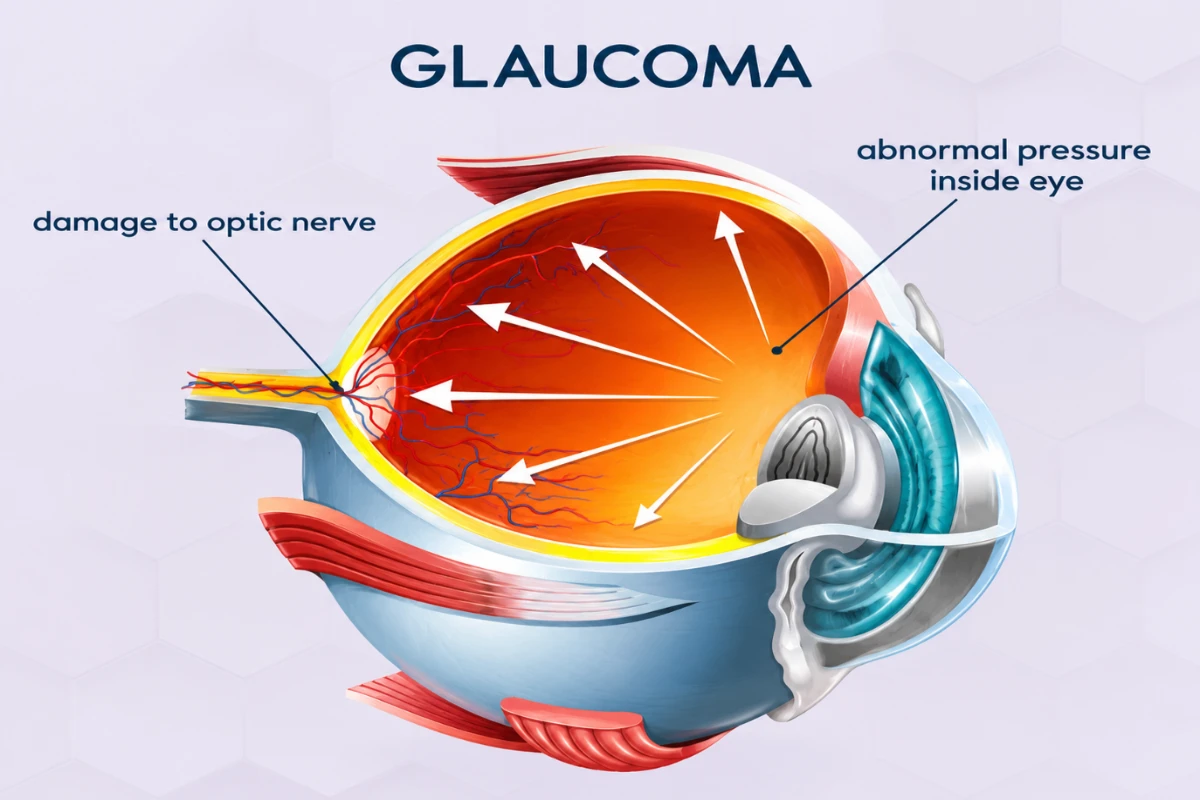
Glaucoma is a group of eye conditions that damage the optic nerve, the structure that carries visual information from the eye to the brain.
This is why glaucoma assessment is not simply about asking:
“Can I see clearly?”
A more useful question is:
“Am I at increased risk, and does my optic nerve need to be assessed?”
For Dr Mandeep Lamba, whose ophthalmic work includes retinal and vitreous conditions, evaluating eye health means looking beyond visual clarity alone and examining the structures inside the eye when clinically appropriate.
What Exactly Is Glaucoma?
Glaucoma refers to a group of eye diseases that can damage the optic nerve.
The optic nerve is made up of nerve fibres that transmit visual signals from the retina to the brain.
In many people with glaucoma, pressure inside the eye is elevated. This pressure is known as intraocular pressure, or IOP.
However, this is an important point:
High eye pressure does not automatically mean you have glaucoma, and glaucoma can also occur in people whose eye pressure falls within a statistically normal range.
This is why simply having your eye pressure measured is not enough to diagnose or rule out glaucoma.
A glaucoma assessment considers the optic nerve, eye pressure and other findings together.
Why Is Glaucoma Often Called a “Silent” Eye Condition?
Because the most common form, open-angle glaucoma, usually does not produce obvious symptoms in its early stages.
A person may:
- read clearly
- drive comfortably
- work on a computer normally
- have no pain
- have no redness
- notice no obvious change in central vision
Yet changes to the optic nerve may still be developing.
As glaucoma progresses, peripheral vision may gradually become affected.
Because both eyes work together and the changes can happen slowly, the brain may compensate for some time.
This is why waiting for noticeable symptoms is not an ideal glaucoma-screening strategy.
What Are the Early Glaucoma Signs?
One of the most important things to understand is:
Early glaucoma often has no noticeable signs.
That is not a vague warning. It is one of the defining clinical challenges of the condition.
The National Eye Institute notes that glaucoma commonly has no symptoms initially, with peripheral vision loss becoming more apparent as the disease progresses.
When symptoms do become noticeable in chronic glaucoma, they may include:
- reduced peripheral vision
- areas of missing vision
- difficulty noticing objects from the side
- progressive narrowing of the visual field
But these are generally not reliable early warning signs.
So if you are searching for early glaucoma signs, the more important question may be whether you have glaucoma risk factors that make an eye examination appropriate.
What Are the Main Glaucoma Risk Factors?
Anyone can develop glaucoma, but some people have a higher likelihood than others.
Important glaucoma risk factors include:
1. Increasing Age
The likelihood of developing glaucoma increases with age.
Older adults therefore generally require more regular comprehensive eye examinations, particularly when additional risk factors are present.
2. Family History of Glaucoma
A family history is particularly important.
If a parent, sibling or another close family member has glaucoma, tell your ophthalmologist.
Family history can influence:
- when screening should begin
- which investigations may be useful
- how frequently your optic nerve should be reassessed
Do not assume that because you currently see well, family history is irrelevant.
3. Elevated Eye Pressure
Higher intraocular pressure is an important glaucoma risk factor.
But eye pressure should never be interpreted as a single pass-or-fail number.
Some people have elevated pressure without developing optic nerve damage, a situation often referred to as ocular hypertension.
Other people develop glaucoma despite having pressures that fall within the usual statistical range.
The pressure measurement therefore needs to be considered together with the optic nerve and other clinical findings.
4. Certain Ethnic Backgrounds
Glaucoma risk and the age at which risk becomes clinically relevant can differ between populations.
Certain groups, including people of African ancestry, have a higher risk of developing open-angle glaucoma and may develop it at a younger age.
Individual screening recommendations should take ethnicity into account alongside family history, age, eye pressure and other findings.
5. Significant Myopia
People with significant short-sightedness, or myopia, may have an increased association with some forms of glaucoma.
Highly myopic eyes can also have optic nerve appearances that require careful interpretation.
This does not mean that everyone who is short-sighted has glaucoma.
It simply means prescription and eye structure form part of an individual’s overall risk assessment.
6. Previous Eye Injury
Certain eye injuries can affect the drainage structures inside the eye and increase glaucoma risk, sometimes years after the original injury.
Always tell your ophthalmologist about previous eye trauma, even if it occurred a long time ago.
7. Steroid Use
Steroid medications can increase eye pressure in some individuals.
This can occur with different forms of steroids, including certain:
- eye drops
- tablets
- injections
- inhaled treatments
- topical medications
The risk varies depending on the medication, dose, duration and individual response.
Do not stop prescribed steroids because of glaucoma concerns without speaking to the doctor who prescribed them.
Instead, tell your ophthalmologist about your medications so that they can determine whether eye-pressure monitoring is appropriate.
8. Certain Eye and Medical Conditions
Some eye conditions and aspects of general health may influence glaucoma risk or the way your ophthalmologist interprets your examination.
This is one reason a glaucoma assessment should include your medical history rather than focusing only on the pressure measurement.
Glaucoma Risk Is Not Based on One Number
Patients are sometimes reassured after being told:
“Your eye pressure is normal.”
That information is useful.
But it does not provide the complete glaucoma assessment.
An ophthalmologist may consider several pieces of information together, including:
- eye pressure
- optic nerve appearance
- family history
- age
- prescription
- corneal thickness
- drainage-angle anatomy
- visual-field findings
- OCT findings, when indicated
- previous measurements and changes over time
This is particularly important because the National Eye Institute notes that tonometry, or eye-pressure measurement, by itself is not sufficient for accurate glaucoma detection.
What Happens During Glaucoma Screening?
If you are considering glaucoma screening in Dubai, your assessment may involve more than one test.
The exact investigations depend on your risk factors and clinical findings.
1. Medical and Family History
Your ophthalmologist may ask about:
- glaucoma in your family
- previous eye problems
- eye injuries
- previous surgery
- medications, particularly steroids
- diabetes or other medical conditions
- your glasses prescription
- previous eye-pressure measurements
This information helps establish your individual risk.
2. Visual Acuity
Your central vision is checked.
However, normal visual acuity does not exclude early glaucoma.
A person with glaucoma may still read the eye chart well, particularly in the early stages.
3. Eye-Pressure Measurement
Intraocular pressure is usually measured as part of the assessment.
This gives your ophthalmologist useful information but should be interpreted together with the rest of the examination.
4. Optic Nerve Examination
This is a particularly important part of glaucoma assessment.
The ophthalmologist examines the optic nerve for features that may indicate glaucoma or require closer monitoring.
The appearance of the nerve can vary naturally between people, which is why comparison over time can also be useful.
5. Dilated Eye Examination
Your pupils may be dilated to allow a clearer view of structures inside the eye, including the optic nerve and retina.
A comprehensive dilated examination can help assess glaucoma as well as other eye conditions.
6. Visual-Field Testing
Glaucoma can affect peripheral vision.
A visual-field test maps what you can see in different areas while you look straight ahead.
This can help identify patterns of functional vision loss that may be associated with glaucoma.
7. OCT Imaging
Optical coherence tomography, or OCT, provides detailed imaging of structures including the optic nerve and retinal nerve-fibre layer.
When clinically indicated, it can help your ophthalmologist:
- document baseline measurements
- assess nerve-fibre thickness
- compare changes over time
OCT is useful, but it is not interpreted in isolation.
A scan result needs to be considered alongside the clinical examination, eye pressure and visual-field findings.
8. Corneal Thickness Measurement
The thickness of the cornea can influence how intraocular pressure measurements are interpreted and may form part of a glaucoma risk assessment.
This test is known as pachymetry.
9. Examination of the Drainage Angle
In selected patients, the ophthalmologist may examine the drainage angle between the iris and cornea.
This assessment, called gonioscopy, can help determine whether the angle is open, narrow or closed and may help distinguish different forms of glaucoma.
Not every patient automatically requires every glaucoma investigation.
Testing should be guided by the individual’s findings.
Who Should Consider Glaucoma Screening?
There is no single screening schedule suitable for every adult.
However, screening becomes particularly relevant when you have recognised risk factors.
You should discuss your glaucoma risk with an ophthalmologist if you:
- have a family history of glaucoma
- have previously been told your eye pressure is elevated
- are getting older
- have significant myopia
- have experienced previous eye trauma
- use steroid medication over an extended period
- have previously been told that your optic nerve looks suspicious
- have another eye condition that may affect glaucoma risk
The National Eye Institute advises people at higher risk of glaucoma to have a comprehensive dilated eye examination generally every one to two years, although the appropriate interval may be shorter depending on individual risk.
Is an Eye-Pressure Check at the Optician Enough?
An eye-pressure measurement is useful, but it should not be treated as a complete glaucoma assessment.
Why?
Because:
Normal pressure does not necessarily exclude glaucoma.
And:
Elevated pressure does not automatically confirm glaucoma.
The optic nerve is ultimately the structure glaucoma damages.
That means pressure needs to be interpreted in the context of:
- optic nerve findings
- visual field
- risk factors
- eye anatomy
- previous results
If screening identifies something unusual, a comprehensive ophthalmic assessment can help determine whether further investigation or monitoring is appropriate.
What If My Eye Pressure Is High but My Optic Nerve Looks Normal?
This may be described as ocular hypertension.
Ocular hypertension means that pressure inside the eye is higher than expected, but clear glaucoma-related optic nerve damage has not been established.
Not everybody with ocular hypertension develops glaucoma.
The decision about monitoring or treatment depends on the individual’s overall risk profile.
Your ophthalmologist may consider factors such as:
- pressure level
- age
- corneal thickness
- optic nerve appearance
- family history
- additional test results
This is another example of why glaucoma management should not be based on eye pressure alone.
Can Glaucoma Occur With Normal Eye Pressure?
Yes.
A form known as normal-tension glaucoma can occur despite measured eye pressure being within a range traditionally considered normal.
This reinforces an important message:
Glaucoma screening is an optic-nerve assessment, not simply a pressure check.
Can Glaucoma-Related Vision Loss Be Reversed?
Vision already lost because of glaucoma generally cannot be restored.
This is why identifying glaucoma before significant functional vision loss becomes apparent is clinically important.
Treatment is aimed at lowering eye pressure and reducing the risk of further optic nerve damage.
Depending on the type and stage of glaucoma, treatment may involve:
- prescription eye drops
- laser procedures
- surgery
The appropriate approach depends on the individual diagnosis and clinical findings.
What Does Dr Mandeep Lamba Consider During an Eye Assessment?
A patient may arrive saying:
“My eyesight is fine. I just want my pressure checked.”
But pressure is only one part of the picture.
For Dr Mandeep Lamba, whose clinical work includes retinal and vitreous conditions, evaluation of the structures inside the eye forms an important part of understanding overall eye health.
When glaucoma risk is relevant, assessment may involve consideration of:
- optic nerve appearance
- intraocular pressure
- retinal findings
- visual function
- family and medical history
- previous eye examinations
- additional investigations when clinically appropriate
If findings suggest glaucoma or require condition-specific management, the next steps can then be discussed according to the patient’s individual clinical needs.
The aim is not to label every person with elevated pressure as having glaucoma.
It is to identify which findings need observation, further investigation or appropriate management.
Is Glaucoma Screening Only for Older Adults?
No.
Age is an important risk factor, but it is not the only one.
A younger adult with:
- a strong family history
- elevated eye pressure
- certain eye anatomy
- previous trauma
- significant myopia
- prolonged steroid exposure
may need assessment earlier than someone without these factors.
Screening schedules should therefore be based on risk rather than age alone.
What About Sudden Eye Pain? Is That an Early Sign of Glaucoma?
Usually, when people talk about glaucoma developing silently, they are referring mainly to open-angle glaucoma.
There is another form called acute angle-closure glaucoma that can present very differently.
Symptoms may include:
- severe eye pain
- red eye
- sudden blurred vision
- nausea or vomiting
This is not something to wait and monitor at home.
Sudden severe eye pain with visual change requires urgent medical assessment.
It should not be confused with the gradual, usually symptom-free early course of open-angle glaucoma.
Conclusion: With Glaucoma, Risk Can Matter Before Symptoms Do
One of the most important things to understand about glaucoma is that waiting for your vision to feel different may mean waiting too long to identify early disease.
The common form of glaucoma may develop without pain, redness or noticeable early visual symptoms.
That does not mean everyone should be worried about glaucoma.
It means knowing your risk matters.
Your:
- age
- family history
- eye pressure
- prescription
- previous eye history
- optic nerve findings
can all help determine whether you need further assessment and how frequently your eyes should be reviewed.
And because glaucoma is an optic-nerve condition, screening should involve more than simply checking the pressure inside your eyes.
For Dr Mandeep Lamba, an important principle when assessing eye health is to look beyond how clearly a patient sees at that moment and consider what the examination of the eye itself shows.
Early identification does not guarantee that vision loss will never occur.
But when glaucoma is detected earlier, appropriate monitoring and treatment can be considered before more advanced damage develops.
Frequently Asked Questions About Glaucoma
1. What are the first signs of glaucoma?
The most common form of glaucoma often causes no noticeable symptoms at first.
As it progresses, peripheral vision may gradually become affected.
This is why screening based on risk factors can be more useful than waiting for symptoms.
2. Who is at greater risk of glaucoma?
Important glaucoma risk factors include increasing age, family history, elevated eye pressure, certain ethnic backgrounds, significant myopia, previous eye injury and some types of steroid exposure.
Your overall risk depends on the combination of factors rather than one risk factor alone.
3. Can I have glaucoma with normal eyesight?
Yes.
Central vision can remain clear during early glaucoma, while optic nerve damage or peripheral visual-field changes may be developing.
4. Can glaucoma happen with normal eye pressure?
Yes.
Some patients develop glaucoma even though their measured intraocular pressure is within the usual statistical range.
This is one reason an eye-pressure check alone cannot exclude glaucoma.
5. Does high eye pressure always mean glaucoma?
No.
Some people have elevated pressure without established optic nerve damage.
This is known as ocular hypertension.
An ophthalmologist can assess whether monitoring, further tests or management may be appropriate based on the person’s overall risk.
6. How often should I have glaucoma screening?
The appropriate frequency depends on your age and individual risk factors.
People at higher risk are commonly advised to have a comprehensive dilated examination every one to two years, although closer follow-up may be recommended for some patients.
7. Does glaucoma screening hurt?
Most components of a glaucoma assessment are non-invasive.
You may receive eye drops for pressure measurement or pupil dilation, and additional tests such as OCT or visual-field testing may be performed where appropriate.
8. What tests are used to check for glaucoma?
Depending on clinical need, assessment may include:
- eye-pressure measurement
- optic nerve examination
- dilated eye examination
- visual-field testing
- OCT imaging
- corneal thickness measurement
- gonioscopy
Not every patient requires every test.
9. Can glaucoma be cured?
There is currently no treatment that restores optic nerve tissue already damaged by glaucoma.
Available treatments aim to lower eye pressure and reduce the risk of additional damage.
The appropriate treatment depends on the type and stage of glaucoma and the individual’s findings.
10. Where can I get glaucoma screening in Dubai?
If you have glaucoma risk factors, have been told your eye pressure is elevated, or are due for a comprehensive eye examination, an ophthalmic assessment can help determine whether glaucoma-specific investigations are appropriate.
Dr Mandeep Lamba’s clinical work includes examination of internal eye structures and the assessment and management of retinal and vitreous conditions.
The investigations required for an individual patient should be determined by their symptoms, clinical findings and glaucoma risk profile.
This article is intended for general educational information and does not replace an individual ophthalmic consultation.


