

When the eye becomes inflamed, treatment often cannot wait. Pain, light sensitivity, blurred vision, and internal inflammation can affect sight quickly, which is why uveitis treatment often begins without delay. Steroids are commonly used first because they act fast and help bring inflammation under control.
But uveitis is not always a short-term problem. In some patients, the inflammation keeps returning or does not settle fully, which means treatment may need to move beyond quick relief and focus on long-term control.
This is why the question is not simply which medicine is stronger. In uveitis treatment, the real goal is choosing the right option at the right stage to protect vision while keeping long-term risks as low as possible.
What Is Uveitis Treatment?
Uveitis is inflammation of the uvea, the middle layer of the eye that includes the iris, ciliary body, and choroid. It can affect the front of the eye anterior uveitis, the back, posterior uveitis, or the entire eye. Symptoms typically include eye pain, redness, light sensitivity, and blurred vision. Without prompt and appropriate management, uveitis can cause lasting damage to vision. Treatment is therefore aimed at reducing active inflammation quickly and then controlling the disease long term to prevent recurrence and protect sight.
Why There Is No One-Size-Fits-All Answer
Uveitis can affect the front of the eye, the middle, the back, or the entire eye. It may happen as a single episode, come back repeatedly, or behave like a long-term inflammatory disease. In some patients, it is linked to an autoimmune condition. In others, it may follow an infection or appear without a clearly identified cause.
That is why two patients with the same broad diagnosis may have very different treatment journeys. One person may improve with a short course of eye drops. Another may need tablets, injections, or longer-term systemic medication. So the real question is not simply which medicine is “better.” The more useful question is which plan controls the inflammation safely and appropriately for that specific type of disease.
How Doctors Usually Build the Treatment Plan
In practical terms, treatment often follows a sequence.
First, the inflammation needs to be brought under control quickly.
Second, the doctor looks at the pattern of the disease. Does this appear to be a short-lived episode, or does it look likely to return or persist?
Third, they decide whether the patient can safely taper off steroids or whether another medicine is needed to keep the inflammation under control in a safer long-term way.
This is why steroids and immunosuppressants are often not direct competitors. In many cases, they are used at different stages for different reasons. One controls the fire quickly. The other may help prevent the fire from coming back too often.
Why Steroids Are Often Used First
Steroids remain a major part of care because they work quickly, and in uveitis, that speed matters. If inflammation is active inside the eye, doctors often do not want to wait weeks for a slower medicine to take effect.
Steroids may be used as:
- eye drops for inflammation in the front of the eye
- tablets for a more significant disease
- injections around the eye
- injections or implants inside the eye in selected cases
This flexibility is one of their biggest strengths. A patient with a milder episode may need only drops. Someone with more severe inflammation may need oral treatment or local steroid delivery. The route depends on where the inflammation is and how severe it is.
What Steroids Do Very Well
Steroids are especially helpful at the start because they can reduce redness, pain, light sensitivity, inflammatory cells, and swelling quite quickly. When sight is at risk, that rapid action is often exactly what is needed.
They are also familiar to eye specialists and can be adjusted in different forms depending on the clinical picture. That makes them very useful in acute care.
For many patients, steroids are the right first step. The difficulty comes when the inflammation lasts longer than expected, returns repeatedly, or only stays quiet while the steroid dose remains too high.
Where Steroids Become a Concern
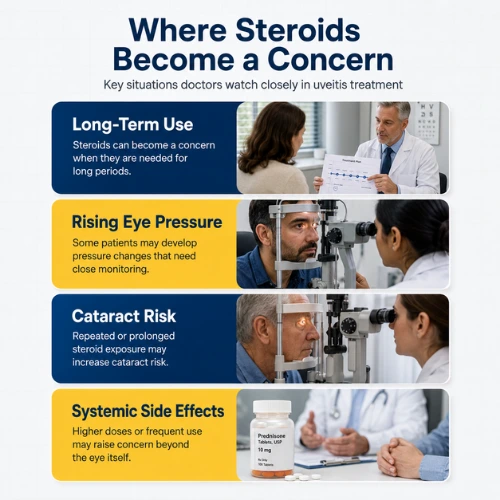
The problem is not that steroids are poor medicines. The problem is that long-term or repeated exposure can create side effects of its own.
Inside the eye, steroids can increase eye pressure and raise the risk of cataract. In the rest of the body, oral steroids may affect mood, weight, blood sugar, blood pressure, bone strength, sleep, and infection risk. So while they are extremely useful, they are usually not something doctors want patients relying on indefinitely if there is a safer, longer-term alternative.
This is often the turning point in management. If the eye flares every time the steroids are reduced, or if side effects are starting to build up, the treatment plan usually needs to evolve.
When Longer-Term Control Becomes More Important
This is the point where steroids vs immunosuppressants for uveitis becomes a meaningful discussion. If the inflammation is chronic, recurrent, affects both eyes, or involves deeper parts of the eye, steroids alone may not be the ideal long-term answer.
In these situations, doctors may use another medicine to reduce steroid dependence. This is sometimes called a steroid-sparing approach. The aim is not to abandon steroids immediately, but to use a second treatment so the steroid dose can be tapered more safely over time.
That approach can be especially important in patients who are doing well on steroids but are only doing well because the dose has remained higher than is comfortable or safe for the long term.
What Immunosuppressive Medicines Are Trying to Do
These medicines work differently from steroids. Steroids are usually the fast-acting option. Immunosuppressive medicines are more often chosen for maintenance, prevention, and long-term control.
Their purpose is to reduce the immune activity driving the inflammation so that the eye can remain quiet without ongoing heavy steroid exposure. They are often considered in patients with repeated flare-ups, bilateral disease, posterior segment involvement, or inflammation that keeps returning during tapering.
Common examples may include:
- methotrexate
- mycophenolate
- azathioprine
- ciclosporin
- selected biologic therapies in more complex cases
The exact choice depends on the type of uveitis, associated medical conditions, blood test profile, age, pregnancy considerations, and how aggressive the disease has been.
Why Patients Often Feel Nervous About This Step
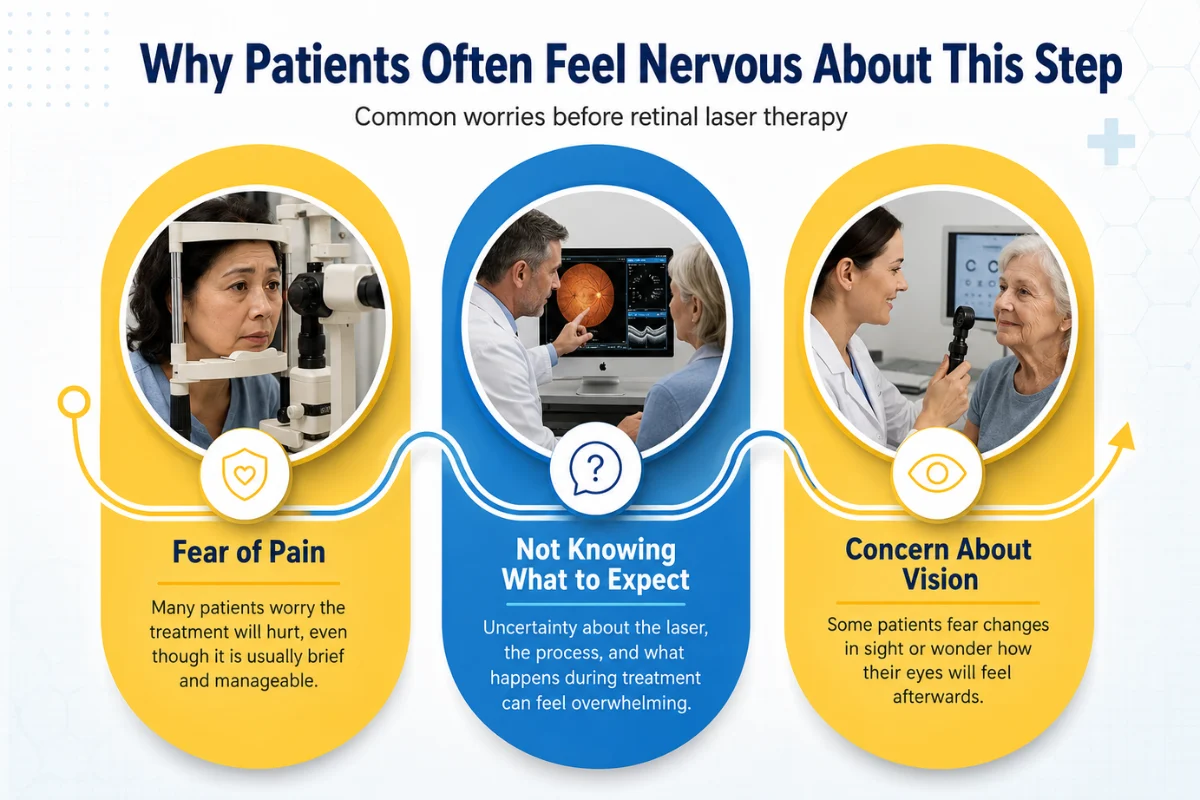
The idea of taking immunosuppressants for eye inflammation can sound worrying. The name itself sounds serious, and understandably so. Patients often wonder whether this means the disease is severe, whether the medicine is dangerous, or whether they are moving into a very heavy form of treatment.
But in the right patient, these medicines may actually be the safer route compared with staying on repeated or prolonged steroid treatment. They are not casual prescriptions, and they do require monitoring, but when chosen properly, they can offer better long-term balance between inflammation control and side effects.
What Doctors Watch Before Recommending Them
Before starting one of these medicines, doctors usually think carefully about:
- How often does the disease relapse
- whether steroid tapering has failed before
- whether one or both eyes are involved
- Which part of the eye is affected
- whether an autoimmune condition may be linked
- what the patient’s general health looks like
- whether blood monitoring will be needed
This is why the plan often feels more personalised at this stage. The treatment is not just about calming the eye today. It is about protecting the eye over months and years.
Which Option Is Better for Ongoing Disease?
The most honest answer is that the best treatment for uveitis inflammation is the one that fully controls the disease with the least long-term harm. For one patient, that may mean a short course of steroid drops and nothing more. For another, it may mean early systemic treatment because the pattern already suggests this is not going to be a one-time episode.
So when patients ask, “Which one is stronger?” that is not always the best question. The better question is, “Which strategy gives me the best chance of controlling this safely over time?”
That question changes the whole discussion. It shifts the focus from drug strength to treatment suitability.
How Long-Term Planning Changes the Journey
When uveitis keeps coming back, the goal shifts from treating flare-ups one by one to preventing the next flare from causing fresh damage. That is where structured follow-up becomes so important.
The range of chronic uveitis management options may include:
- slow tapering of steroids
- adding a steroid-sparing medicine
- local steroid injections or implants in selected cases
- regular eye pressure checks
- cataract monitoring
- Blood tests were required
- for coordination with rheumatology or internal medicine if needed
This matters because even if each episode eventually settles, repeated inflammation can still leave behind cumulative damage. Good care is not only about getting rid of symptoms this week. It is about preserving vision for the long term.
Why the Choice Is Often Not Either-Or
Many patients assume they must choose one side: steroids or immunosuppressants. In reality, the treatment plan is often sequential.
A patient may begin with steroids to settle the inflammation fast. If the disease behaves well and does not return, that may be enough.
Another patient may improve initially, but relapses as soon as the dose falls. In that situation, an additional medicine may be introduced to help maintain control more safely.
So the real answer is often not about picking a winner. It is about building the right treatment pathway.
Questions Patients Should Ask in the Clinic

A good ophthalmologist consultation does not only explain what medicine is being prescribed. It should also explain the wider plan.
Helpful questions include:
- Is this likely to be a one-time episode or a recurring problem?
- Are steroids enough for now, or do you expect I may need longer-term treatment?
- What side effects are you most concerned about in my case?
- How will you monitor eye pressure, cataract risk, and overall response?
- If another medicine is needed, how long might it take to work?
- Will I need blood tests or support from another specialist?
These questions often help patients understand why the plan may change over time and why a treatment that sounds “stronger” may actually be more appropriate in the long run.
When Specialist Review Matters Most
For patients looking for uveitis treatment in Dubai, the important thing is not simply getting a prescription quickly. It is getting the type of inflammation properly identified, understanding whether it is likely to recur, and building a treatment plan that controls the disease without creating avoidable complications from the treatment itself.
That is where specialist care becomes especially valuable. The right diagnosis shapes the right medicine.
Conclusion
The goal in uveitis treatment is not choosing steroids or immunotherapy blindly. It is choosing what controls inflammation safely and protects vision long-term. For some patients, steroids are the right first step. For others, especially when inflammation keeps returning, a steroid-sparing plan may be the safer long-term option.
If you are dealing with repeated eye inflammation or prolonged steroid use, do not guess the next step. Contact Dr Mandeep Lamba on +971 52 422 7000 for a specialist review and a treatment plan tailored to your type of uveitis.
FAQs
Are steroids always the first choice?
Often, yes, especially when inflammation needs to be controlled quickly. But the route and dose depend on where the inflammation is and how severe it is.
Do immunosuppressants replace steroids completely?
Not always. In many cases, they are added so steroids can be reduced more safely, rather than stopped immediately.
Are these medicines only used in very severe cases?
Not only very severe cases, but they are also more commonly used when the disease is recurrent, chronic, bilateral, posterior, or too steroid-dependent.
Can long-term steroid use affect the eye?
Yes. It can raise eye pressure and increase cataract risk, especially when exposure is prolonged.
Is there one best medicine for every patient?
No. The best choice depends on the type of uveitis, the pattern of the disease, associated health issues, and how the patient responds to treatment.


