

A sudden bend in straight lines. Words that look smudged in the middle. Faces that seem harder to recognise, even though your glasses have not changed. For many patients, wet age-related macular degeneration starts exactly like this: not always with dramatic pain, but with quiet changes in central vision that begin to interfere with normal life. That is why wet Age-Related Macular Degeneration AMD treatment is not something to postpone or “watch for a while.
”Wet AMD affects the macula, the part of the retina responsible for sharp central sight, and it can damage vision quickly if the leaking blood vessels underneath are not controlled early. Anti-VEGF injections have changed this story in a major way, because they can reduce leakage, settle retinal swelling, and help many patients hold on to useful sight for reading, recognising faces, and day-to-day independence.
What Wet AMD Actually Means
Age-related macular degeneration has two main forms: dry AMD and wet AMD. Dry AMD is more common and usually progresses more slowly. Wet AMD is less common, but it is the more urgent form because abnormal blood vessels grow under the retina and leak fluid or blood into the macular area. That leakage is what threatens central vision. The National Eye Institute explains that these abnormal vessels can bleed or leak, damaging the macula and affecting the ability to see clearly straight ahead.
Patients often describe the early changes in simple but important ways. Straight lines may begin to look wavy. Print may seem blurred or incomplete. A grey patch may appear in the middle of vision. These are the kinds of symptoms that should never be brushed off as “just age” or tired eyes, because the earlier active disease is controlled, the better the chance of protecting sight.
Why Injections Became the Main Treatment
The idea of an injection into the eye sounds frightening to almost every patient the first time they hear it. That reaction is completely normal. But the reason retina specialists recommend it is very straightforward: the medicine blocks VEGF, a protein that drives the growth and leakage of these abnormal blood vessels. By blocking VEGF, the treatment helps reduce fluid, control bleeding, and protect the macula from further damage. The NEI states that anti-VEGF injections are the most common treatment for wet AMD and that most people receive them as the main therapy.
This is also where modern care has made such a difference. Before anti-VEGF therapy, long-term outcomes for wet AMD were much poorer. With current treatment, many patients are now able to stabilise vision, and some improve from the point at which they first presented.
Why Treatment Is Usually Repeated, Not One-Time
One of the most important things patients need to understand early is that this is usually a management plan, not a single procedure that “fixes” everything in one visit. Anti-VEGF medicines only work for a limited period, which is why repeat treatment is often needed. The NEI notes that most people need injections once a month at first, and after that, the schedule may be adjusted depending on how the eye responds.
That starting phase of monthly eye injections for wet AMD is not a sign that the condition is out of control. In many patients, it is simply the standard way to bring active disease under control before deciding whether treatment intervals can later be extended. Some eyes can move to longer gaps between visits, while others need closer treatment to stay dry and stable.
What Happens During the Injection Visit
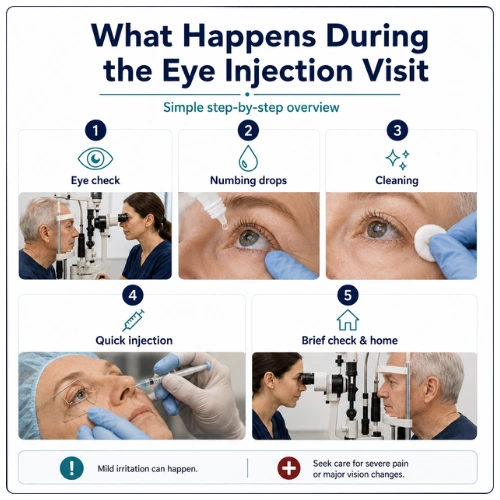
This is usually the point where patients feel the most anxious, so it helps to explain it clearly. The procedure is typically quick and carefully organised. According to the NEI, the eye is numbed first, then cleaned to lower infection risk, and the medicine is placed into the eye with a very small needle.
In practical terms, a visit usually includes:
- numbing drops or anaesthetic
- careful cleaning of the eye
- gentle positioning of the lids
- the injection itself
- a short check afterwards
Most patients describe the injection as uncomfortable or strange rather than truly painful. Mild irritation, watering, or a gritty feeling can happen afterwards, and a small red patch on the white of the eye is also possible. Hospitals routinely advise patients to report severe pain, significant worsening of vision, or increasing redness after the injection because those symptoms need urgent review.
How Doctors Know the Injections Are Working
Patients often expect vision alone to tell the full story, but wet AMD is monitored much more carefully than that. Retina specialists use symptoms, examination findings, and scans such as OCT to see whether fluid is settling or returning. AAO sources note that treatment schedules such as treat-and-extend rely on regular OCT assessment to judge whether the retina is dry and whether intervals can be adjusted safely.
These scans help doctors look for:
- fluid within or under the retina
- change in macular thickness
- ongoing swelling
- signs that the disease has become active again
This is why follow-up matters even if the patient feels “roughly the same.” The scan may show improvement before the patient notices it, or recurrence before vision has obviously dropped. That close monitoring is one of the main reasons treatment outcomes are better today than they used to be.
How the Injections Protect Sight
When patients ask how eye injections save vision in AMD, the answer is that they work by controlling the leakage and bleeding before the retina suffers more permanent injury. The medicine blocks the signal that abnormal blood vessels use to grow and leak, which allows the macula to become drier and more stable. In many eyes, that means vision can be stabilised. In some, it also means measurable visual improvement. The NEI says anti-VEGF injections help stop bleeding and leaking from blood vessels in the back of the eye, which is the central mechanism behind the treatment.
This is also why timing matters so much. The aim is often to save vision rather than promise perfect vision. If treatment begins early, before heavy scarring or major macular damage develops, outcomes are usually better. If treatment starts later, the disease can still often be controlled, but not all sight may be restored.
Wet AMD and Dry AMD Are Not Managed the Same Way
Many patients hear the words “macular degeneration” and assume the same treatment applies to everyone. It does not. Wet vs dry AMD treatment options are different because the disease process is different. Wet AMD is mainly treated with anti-VEGF injections because the central problem is leaking abnormal blood vessels. NHS guidance lists anti-VEGF injections as the main treatment for wet AMD, with light-based therapy used in some cases. For dry AMD, there is no equivalent injection-based standard treatment in the same way; management typically focuses on monitoring, lifestyle measures, low-vision support, and, in selected patients, specific supplements or newer therapies depending on the stage.
That distinction matters because one of the biggest mistakes is assuming all AMDs behave slowly. Wet AMD is the form that usually needs prompt retinal care.
Does This Cure Wet AMD Forever?
This is one of the most common questions in the clinic, and patients deserve a clear answer. Anti-VEGF injections usually control wet AMD rather than cure it once and for all. The disease can reactivate, which is why long-term review often remains part of care even after the retina becomes stable. Some patients eventually need fewer injections. Others continue on ongoing treatment at varying intervals.
That does not mean treatment has failed. It means wet AMD is often a chronic retinal condition, and the real goal is preserving useful central vision over time.
Common Worries Patients Have Before Starting

Patients often come in with the same understandable concerns.
Will it hurt?
Usually, it is more manageable than people expect because the eye is numbed first, and the procedure is very quick.
What happens if I delay treatment?
Delay can be costly because active leakage gives the macula more time to suffer damage. Early treatment is one of the most important predictors of better outcomes.
Can I skip appointments if vision seems stable?
That is risky. Reactivation can appear on scans before a patient notices a major subjective change.
Will I need injections forever?
Not always, but some patients do need long-term care. The schedule depends on how the retina behaves over time.
Practical Advice for Living With Wet AMD
A new diagnosis can feel overwhelming, especially when treatment starts quickly. What helps most is understanding that regular care is part of vision protection, not a burden added for no reason.
Useful habits include:
- Keep every retina appointment unless your specialist advises otherwise
- report new distortion, sudden blur, or a central shadow promptly
- Use an Amsler grid if your doctor recommends it
- Stop smoking if you smoke
- Bring your questions to the clinic instead of relying on random online advice
- treat the injection schedule as part of protecting independence and daily function
These steps may sound simple, but they matter because the best results often come when the patient and retina specialist stay closely aligned on follow-up and treatment.
Seeking Timely Retinal Care in Dubai
For patients considering wet AMD treatment injections in Dubai, the key is not simply finding somewhere that offers injections. It is getting a proper retinal diagnosis, high-quality imaging, a clear treatment plan, and follow-up that is guided by disease activity rather than guesswork. Wet AMD is one of those conditions where timing, consistency, and monitoring work together. When those pieces are in place, the chance of preserving sight is much stronger.
FAQs
Are injections the only treatment for wet AMD?
They are the main standard treatment for most patients. NHS guidance also notes that light treatment may be used in selected cases, but anti-VEGF injections are the common frontline approach.
How soon do injections start working?
Some eyes show drying and stabilisation fairly quickly, but the response varies. Doctors judge progress over time using both vision checks and OCT scans.
Can treatment improve vision, or only stop worsening?
It can do both. Many patients stabilise, and some gain vision, especially when treatment starts before major retinal damage develops.
Is wet AMD always more urgent than dry AMD?
In general, yes. Wet AMD is usually more urgent because it can damage central vision faster, even though dry AMD is more common.
Conclusion
Wet AMD does not usually wait, and that is exactly why early action matters so much. The real solution is not to sit with distortion, blur, or a new central patch and hope it settles. It is to confirm the diagnosis quickly, start the right injection plan early, and stay consistent with follow-up so the retina has the best possible chance of remaining stable.
In many patients, that is what allows useful central vision to be protected for reading, recognising faces, and maintaining day-to-day independence. For expert retinal assessment and timely treatment, contact Dr. Mandeep Lamba at Prime Hospital, Al Garhoud, Dubai, on +971 50 407 2552 and get the right plan in place before more vision is lost.


