
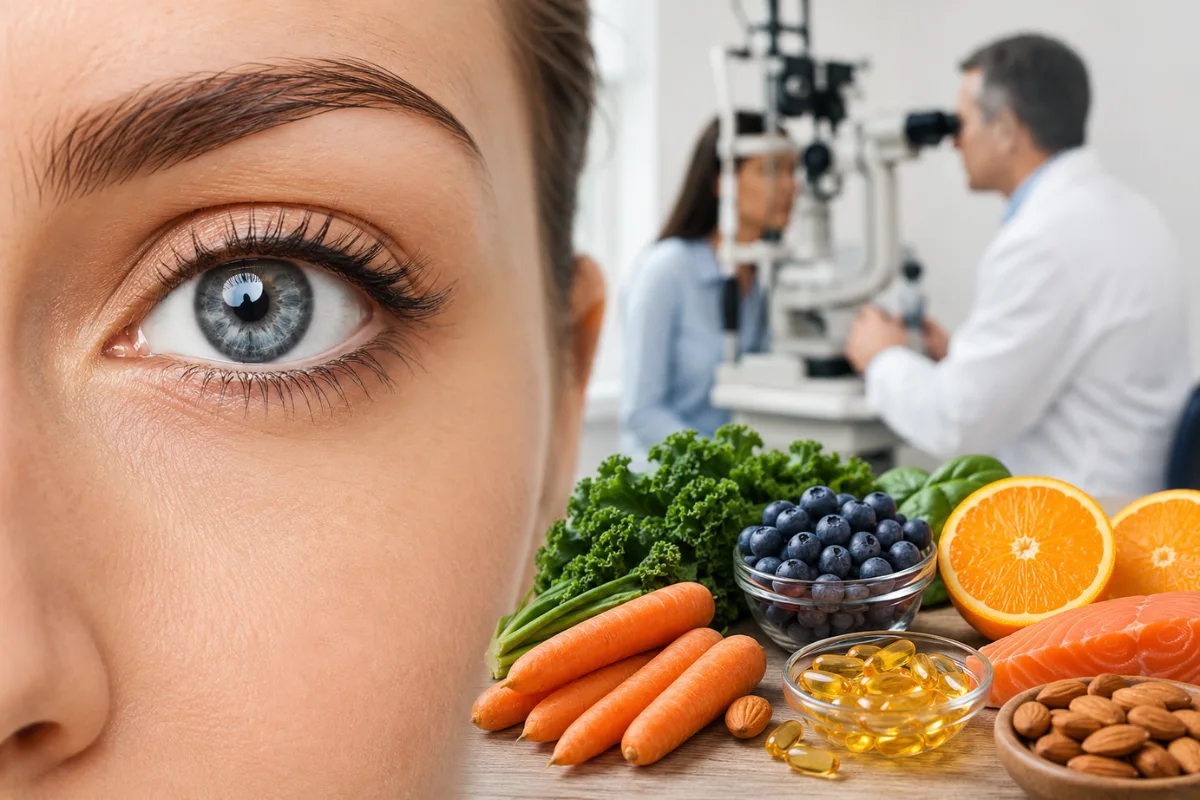
Most people do not think about their retina until they hear words like macular degeneration, retinal damage, or vision loss. That is when the question suddenly becomes urgent: Is there anything I can do now to protect my eyesight before it gets worse? It is a fair question, and one many patients ask when they start worrying about long-term vision or after consulting a retina specialist Dubai for early signs of retinal disease.
That is exactly why vitamins for retina health get so much attention. They sound practical, simple, and proactive. And while the right nutrients can support eye health, not every supplement is useful for every person or every retinal condition. Some formulas have real scientific value, especially in specific cases like age-related macular degeneration, but supplements are not a cure, and they are not one-size-fits-all. Understanding what actually helps, and when, is what matters most.
Why the Retina Depends on Good Nutrition
The retina is the light-sensitive tissue at the back of the eye. It works continuously, processing visual information and sending signals to the brain. Because it is highly active, it is also exposed to oxidative stress over time. That is one of the reasons researchers have looked closely at whether antioxidants and certain carotenoids can help support retinal health, particularly in age-related macular degeneration, or AMD.
This does not mean a few capsules can reverse retinal damage that has already occurred. It means that, in the right setting, carefully studied nutrients may support the retina as part of a broader care plan. That difference matters because many patients are sold the idea that all eye vitamins are protective simply by virtue of sounding healthy.
What Science Actually Supports
When doctors discuss nutritional support for the retina, they are usually not referring to random multivitamins. They are referring to the AREDS and AREDS2 formulations studied by the National Eye Institute. These studies showed that AREDS2 supplements can reduce the risk of progression from intermediate to advanced AMD by about 25 per cent in people who fit the trial criteria. Just as importantly, the same research found no benefit for people who do not have AMD, and no benefit for people with early AMD alone.
That is the most important takeaway for patients. The strongest evidence is not “everyone should take an eye vitamin.” The strongest evidence is that a specific formula can help certain patients with a specific retinal condition. That is why the best supplements for retinal health are not necessarily the most expensive or most heavily advertised ones. They are the ones that actually match the condition being treated and the evidence behind it.
The Main Nutrients That Matter Most
Lutein and Zeaxanthin
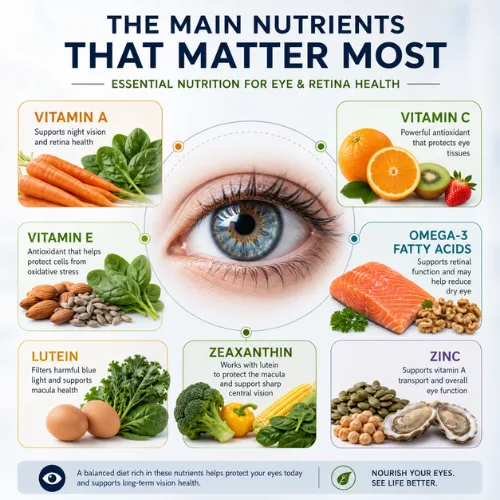
These are two carotenoids found naturally in the macula, the part of the retina responsible for detailed central vision. They are thought to help filter harmful light and reduce oxidative stress. The body cannot make them, so they must come from diet or supplements. The American Academy of Ophthalmology notes that leafy green vegetables are among the best food sources of these nutrients.
When patients ask about lutein zeaxanthin for eye health, this is one of the few supplement conversations with a strong scientific foundation. In AREDS2, these nutrients replaced beta-carotene in the updated formula. That change mattered because beta-carotene was linked to increased lung cancer risk in current and former smokers, while lutein and zeaxanthin offered a safer alternative in that setting.
Vitamin C and Vitamin E
These antioxidants remain part of the AREDS2 formula. Their role is not that they should be taken alone as a cure for retinal disease. Their value comes from being part of a tested combination used in selected AMD patients. That point is often missed when people buy isolated supplements and assume the evidence applies in the same way.
Zinc and Copper
Zinc has long been included in AMD-related supplement research because it supports several important cellular functions in the retina. Copper is added alongside zinc because high-dose zinc can interfere with copper absorption. This is a good example of why evidence-based formulas are better than self-mixing ingredients at random.
What Counts as a Truly Evidence-Based Formula?
If we stay close to the strongest research, the most honest answer is this: science backed vitamins for retina mainly refers to an AREDS2-style formula in the right patient, not a generic eye-health supplement for everyone. The typical AREDS2 components are vitamin C, vitamin E, zinc, copper, lutein, and zeaxanthin. According to the National Eye Institute, this formulation may help slow progression from intermediate to advanced AMD, but it does not prevent AMD from starting, and it does not reverse advanced damage that is already there.
This is especially important for patients with other retinal conditions such as diabetic retinopathy, retinal vein disease, or inherited retinal disorders. Good overall nutrition still matters, but the same supplement evidence cannot simply be copied across every retinal diagnosis.
Are Omega-3s Part of the Story?
Many patients expect omega-3 fatty acids to be a key part of retinal supplement advice. Omega-3s are valuable for general health and may be useful in other eye-related discussions, especially dry eye. But in AREDS2, adding omega-3 fatty acids did not provide extra benefit in reducing progression to advanced AMD. That is why they are not the headline recommendation when the topic is retinal nutrition for AMD risk reduction.
That does not make oily fish unhelpful. It simply means we should not overclaim what omega-3s can do in this particular retinal setting when the main trial did not show added AMD benefit.
Can Food Be Enough?
For many people, food is the right place to begin. A healthy eating pattern rich in leafy greens, colourful vegetables, fruits, beans, nuts, and fish supports overall eye health. The American Academy of Ophthalmology encourages this kind of diet and specifically points to vegetables such as kale, spinach, collards, and Swiss chard as useful sources of lutein and zeaxanthin.
This matters because some patients want to skip the diet and go straight to supplements. That is rarely the smartest approach. Supplements do not replace good nutrition, smoking avoidance, blood pressure control, diabetes management, and regular retinal checks. Those basics still carry enormous weight in protecting long-term vision.
Can Vitamins Stop Macular Degeneration Before It Starts?
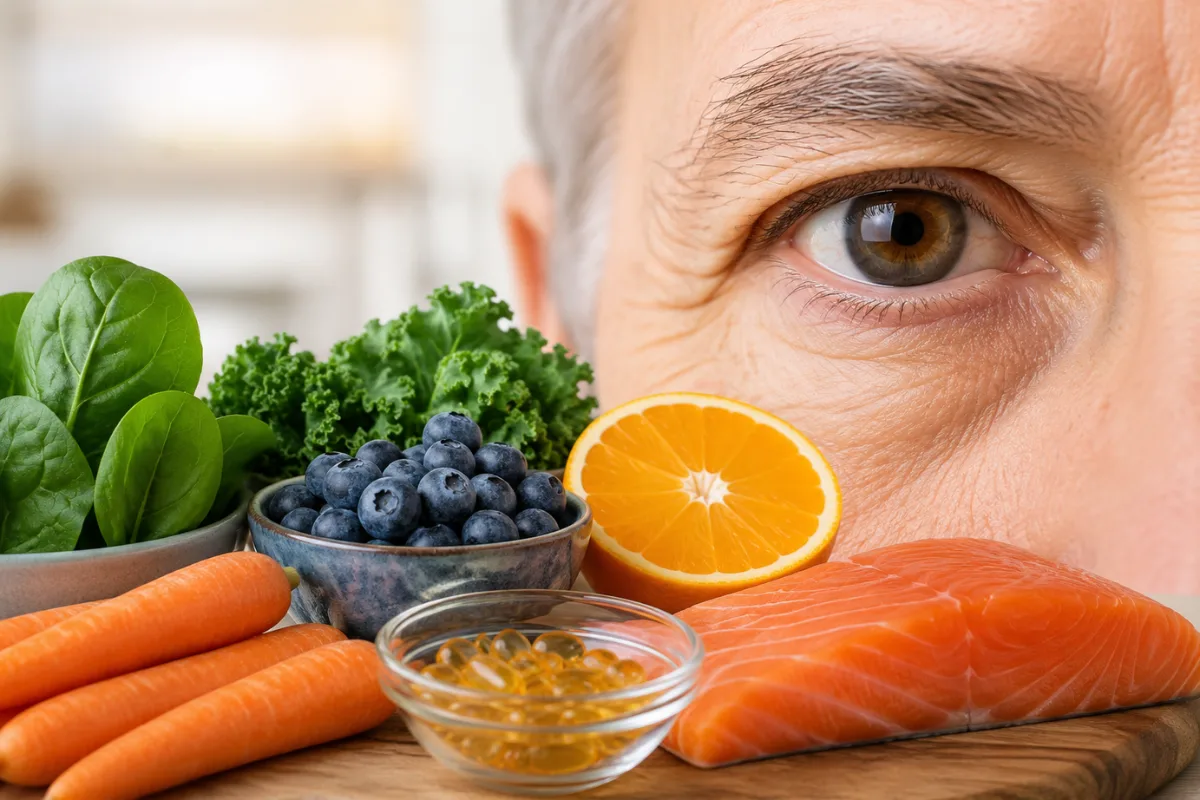
This is where expectations often become unrealistic. The phrase vitamins to prevent macular degeneration sounds reassuring, but it oversimplifies what the evidence really shows. AREDS2 supplements do not prevent AMD from starting in healthy eyes, and they do not benefit people without AMD. Their proven role is in slowing progression in selected patients who already have intermediate AMD, or advanced AMD in one eye.
So prevention, in the broader sense, still depends far more on healthy habits, smoking cessation, regular eye examinations, and timely diagnosis than on taking a supplement “just in case.”
Who Should Be Careful With Supplements?
Not every supplement suits every patient. Smoking history matters because of the beta-carotene issue. General medical history matters too, especially if someone has kidney disease, is taking multiple medications, or is unsure whether their retinal diagnosis actually fits the evidence for a high-dose eye formula. The AAO advises that people considering eye vitamins should discuss them with their ophthalmologist rather than self-prescribing based on marketing.
That conversation is important because the right supplement is not just about ingredients. It is about whether the supplement belongs in your treatment plan at all.
What Vitamins Cannot Do?
This is the part patients deserve to hear clearly. Vitamins cannot reattach a retina. They cannot remove a cataract. They cannot replace injections for wet AMD. They cannot undo major retinal damage that has already happened. And they cannot guarantee that someone with excellent supplement habits will never develop eye disease.
What they can do, in the right patient and the right stage of disease, is contribute meaningfully to a broader management plan. That is useful, but it is not magic. Honest retinal care always works best when supplements are placed in their proper role, not exaggerated beyond the evidence.
A Practical Way to Think About It
If you are wondering whether you need an eye supplement, the best place to start is not the pharmacy shelf. It is the diagnosis.
If an eye specialist has told you that you have intermediate AMD or a retinal condition where a specific formula is appropriate, then an evidence-based supplement may be worth discussing. If not, then the better starting point is usually a stronger diet, regular retinal examinations, and proper control of risk factors such as smoking, diabetes, and blood pressure.
That may sound less exciting than the promise of a daily vision capsule, but it is much closer to what the science actually supports.
FAQs
Should everyone over 40 take an eye supplement?
No. The strongest evidence is not for everyone over 40. It is mainly for people with intermediate AMD or advanced AMD in one eye.
Are over-the-counter eye vitamins all the same?
No. Products vary widely in ingredients and doses. A supplement that does not match the AREDS2 evidence is not automatically offering the same benefit.
Can I rely on food alone?
A healthy diet is essential and should always be encouraged. But for patients who fit AREDS2 criteria, diet is not identical to the trial-tested formulation.
Is beta-carotene still recommended?
It is generally avoided in AMD formulas for current and former smokers because of the lung cancer risk seen in research.
Will these supplements improve normal eyesight?
They are not designed to sharpen normal vision in otherwise healthy eyes. Their evidence-based role is mainly in slowing AMD progression in selected patients.
Conclusion
Retinal supplements can be helpful, but only when they are chosen for the right reason and used in the right clinical context. The real solution is not to guess based on advertising or start random eye vitamins out of fear. It is to first understand what is happening in your retina, whether you actually have a condition that fits the evidence, and what combination of diet, monitoring, treatment, and supplementation is most appropriate for you.
If you are concerned about retinal health, the most useful next step is a proper retinal assessment rather than self-prescribing supplements. For personalised guidance in Dubai, contact Dr. Mandeep Lamba at Prime Hospital, Al Garhoud, Dubai, on +971 524 227 000 to find out whether supplements truly have a role in your eye care plan and what will genuinely help protect your vision.


